
The Two Ingredients to Achieving Any Goal
I firmly believe that two key ingredients determine whether you’ll achieve any goal:
- You must want it badly enough.
- You must truly believe you can achieve it.
These two factors are deeply intertwined. If you want something badly enough, you’ll do whatever it takes (within your values and moral compass) to achieve it. And when you’re willing to do whatever it takes, success is inevitable.
However, for your thoughts, words, and actions, to fully align with your goal, you must genuinely believe that you can do it – not just at a surface level, but deep within your subconscious.
If you don’t have that deep-rooted belief, you’re working against internal blocks that will hold you back.
Why Writing Helps Break Through Mental Blocks
Many people think of writing as just a way to journal thoughts or plan ideas, but it’s so much more than that. Writing is one of the most powerful ways to access your subconscious mind.
The simple act of putting your thoughts onto paper helps you:
- Identify limiting beliefs that are holding you back
- Challenge negative thought patterns with logic
- Rewire your mindset with new empowering beliefs
Writing forces you to confront your thoughts head-on. Unlike thoughts which may come and go, the written word makes abstract ideas tangible and real – and that’s when real transformation happens.
A Writing Exercise to Uncover Mental Blocks
If you’re serious about achieving a big goal, here’s a writing exercise that can help you identify and overcome the hidden beliefs that are keeping you stuck.
Step 1: Write Your Goal as an “I AM” Statement
State your goal in the present tense, as if you’ve already achieved it. This helps program your mind to start believing it’s possible. You begin to “future-pace” yourself, which is a neuro-linguistic technique to create positive expectations, which gives you the experience of feeling and enjoying the desired results right now.
Some examples:
- “I AM strong, fit, and full of energy every single day.”
- “I AM an expert in my field, sought after for my knowledge and skills.”
- “I AM earning [insert target income] per year doing work I love.”
My personal example:

Step 2: Pay Attention to Your Emotional Reactions
As you write this statement, notice your gut reaction.
- Do you feel excited and confident?
- Or do you feel doubt, hesitation, or even anxiety?
Write down every emotion that comes up. Be brutally honest with yourself.
My personal example:
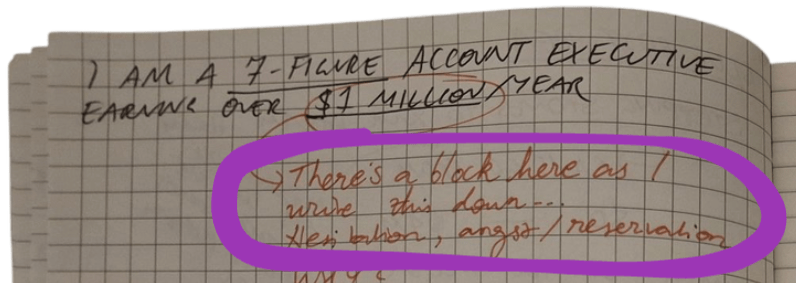
Step 3: Identify Your Limiting Beliefs
Now, ask yourself: Why do I feel this way?
List all the reasons that come up, even if they seem irrational.
These doubts might feel real, but they’re just stories your subconscious is telling you. And stories can be rewritten.
My personal example:

Step 4: Challenge & Reframe the Beliefs
Now, counteract each limiting belief with logic, reason, past wins, and positive affirmations.
✔ What evidence do I have that proves I CAN do this?
✔ Have I achieved big goals before?
✔ What actually separates those who achieve this goal from me?
My personal example:

In my case, one of the breakthrough reasoning questions that I asked myself was essentially – what is the difference between those sellers who achieve this goal and me?
I started to list down what I thought the differences were:
- They ruthlessly prioritise their time and effort
- They sell high ticket ‘mega deals’ instead of focusing on small opportunities
- They have deep account penetration and multi-thread across the organisation extremely well
- They sell to the c-suite and build c-level champions
- They leverage an entire team to sell, they aren’t lone wolves
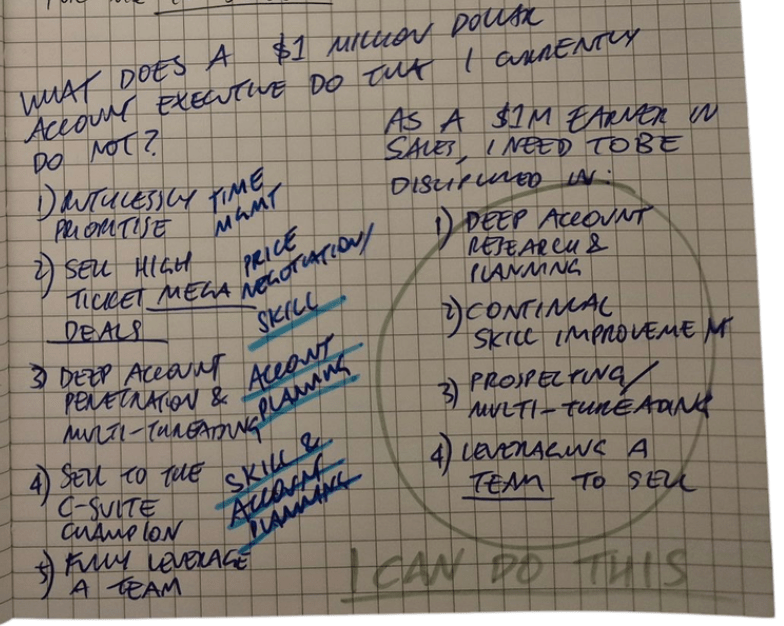
And that’s when it hit me: the difference isn’t experience, talent, or being “good enough” – it’s habits. The top performers aren’t necessarily “better” than me. They just operate differently. I’ve heard this advice before, but this was the first time I really felt it.
Recognising that success comes down to habits was a breakthrough moment. Instead of obsessing over the $1M goal, I should be asking: What can I do TODAY that moves me toward it?
When I broke down my goal into daily behaviours, it no longer felt intimidating. I immediately felt more equiped to reach my goal. The $1M number might be bold and intimidating, but the behaviours that I can do every day that will lead me there are not. I’m not going to wake up overnight and achieve this, but I can commit to the disciplines that move me one step closer every day.
I’m reminded by the Alex Hormozi quote:
“Extraordinary accomplishments come from doing ordinary things for extraordinary periods of time.”
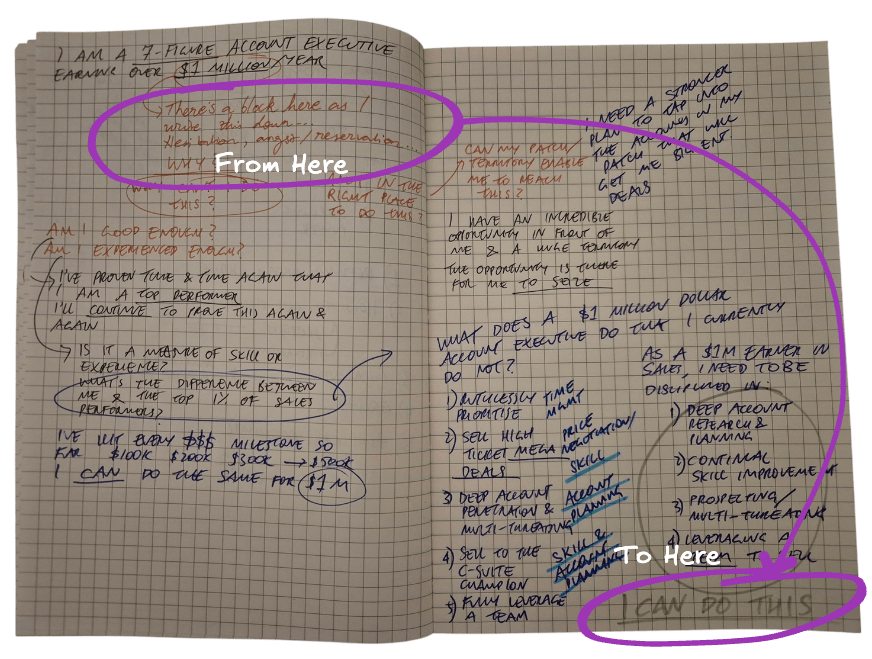
Your Challenge: Do the Writing Exercise
If you’ve ever felt stuck chasing a big goal, try this:
- Write your goal as an “I AM” satement.
- Pay attention to how it makes you feel.
- List our every limiting belief that surfaces.
- Challenge those beliefs with logic, reasoning, past wins and positive affirmations
- Identify the key habits and behaviours that will get you there
Final Thoughts
Success isn’t about luck, and it’s not just about working harder – it’s about aligning your thoughts, words, and actions with your goals. Writing is one of the best ways to break through mental barriers and start acting like the person who has already achieved what you want.
If you’ve enjoyed this read, please share it with someone who you think may enjoy it too.
 AT Full Potential