
Author’s Note
Why do so many people try to manifest what they want… and still feel stuck?
This piece was written as a synthesis of insights that have shaped how I see manifestation, creativity, and personal power.
I noticed a common thread among distinct books and voices on the idea of manifestation:
- Reality Transurfing by Vadim Zeland
- Ask and It Is Given by Abraham Hicks
- Conversations with God by Neale Donald Walsch
- Think and Grow Rich by Napoleon Hill
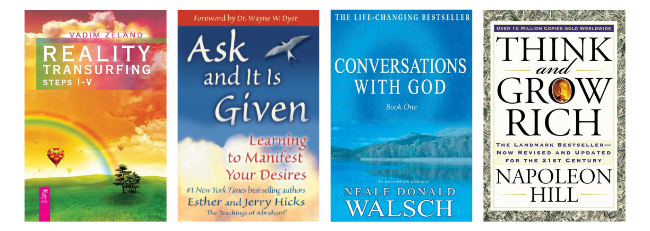
There are many others, but these are the main ones.
On the surface, they seem like separate ideologies— one Russian quantum mystic, one channeled entity, one modern spiritual philosopher, and one early 20th-century self-development author. But the deeper I go, the clearer it becomes:
You don’t get what you want. You get what you choose to be, consciously or unconsciously.
Each author offers their own lens through which to observe the same principle. Zeland talks of “choosing your life path”, Hicks of “vibrational harmony and alignment”, Walsch of a “knowingness”, and Hill of “desire and faith”. But the thread is unmistakable.
The Illusion of (and Problem with) Asking
Most of us were raised with the idea that to get what we want, we must ask for it— often humbly, perhaps desperately—from a higher power. The higher power, we’re told, might grant us our wish… once certain virtues are proven or conditions met.
But what if there’s a flaw to this framework? What if asking from separation is why so many never receive?
This paradigm of asking creates distance. It assumes power lies outside of us.
Neale Donald Walsch writes:
“You will not have that for which you ask, nor can you have anything you want. This is because your very request is a statement of lack.”
When you ask from that place, your vibration says “I don’t have this.” And what you radiate is what you attract.
Across teachings:
- Zeland says wanting creates excess potential, which invites balancing forces to push your desire away.
- Hicks says the Universe doesn’t respond to words— it responds to dominant emotional frequency.
- Walsh reminds us that God is always saying yes— to whatever you declare your life to be
- Hill urges us to move beyond hope into burning, unwavering desire backed by faith.
Choosing, Not Begging
Walsh writes:
“When you thank God in advance, you acknowledge that all things have already been given. This knowingness is the key to creation.”
This is the shift:
- From Battling → Choosing (Zeland)
- From Hoping → Aligning (Hicks)
- From Asking → Knowing (Walsh)
- From Wishing → Unwavering Faith (Hill)
What each teacher is essentially saying is: You don’t manifest the life you want by trying harder.
You manifest by becoming clearer, calmer, and more deliberate in what you choose your life be and in what you choose to experience.
It doesn’t happen all at once. It unfolds in subtle shifts—
By gradually observing and adjusting your thoughts.
By acting as if.
By tuning into faith and a knowingness that life is happening for you, not to you.
It takes time, patience, and practice. But these quiet shifts move you from a passive seeker to a conscious participant— no longer begging for life to change, but choosing the path ahead with certainty.
Faith is Knowing, Not Hoping
Faith isn’t passive. It isn’t hope. It’s a knowing that what you’ve chosen is already on its way— or is even already done.
Through Zeland’s worldview— intention should be a quiet knowing, rather than anxious effort.
“Once you have subconsciously accepted the possibility of failure, do not think about failure or success. Just move in the direction of your goal… Success will be in the bag…”
Hicks says “If you want it and expect it, it will be yours very soon.”
Celebrating expectancy as the bridge between desire and delivery.
Walsch writes “For you are the creator of your reality, and life can show up no other way for you than that way in which you think it will.”
Hill alludes to the unseen processes in motion, initiated by faith in saying that:
“When faith is blended with thought, the subconscious mind instantly picks up the vibration, translates it into its spiritual equivalent, and transmits it to Infinite Intelligence.”
Faith is the steady emotional frequency of having. Not trying. Not waiting. Of having. Of considering it already done.
The Reality Lag
Every teaching highlights the time lag between thought and manifestation as a natural process and a blessing: it gives us time to align.
In Zeland’s view, it is the time it takes for us to set in motion the required state to change life paths.
Hill views persistence as the bridge across the lag.
If everything manifested instantly, every fearful or contradictory thought would create chaos. The lag is protective. It favours the consistent.
Our job isn’t to panic in the gap. It’s to maintain alignment with our vision and to hold faith through the gap.
Focus on What You Want, Not What You Fear
Another consistent principle across these teachings is that the universe does not understand “no”; it only understands focus. If you focus on lack, you energise it. If you focus on abundance, you magnetise it.
As Hicks puts it:
“When you focus on the problem, you hold yourself in vibrational harmony with the problem. When you look for a solution, you hold yourself in vibrational harmony with the solution.”
In other words, your energy either perpetuates lack or allows for abundance.
Zeland explores the same idea through the mechanics of the “alternatives space” theory. Your attention feeds energy into whichever frame you inhabit, strengthening its reality. He emphasises the distinction between battling for something, versus choosing it with a calm certainty.
At the heart of these teachings is the reminder that reality mirrors your focus. Fear and doubt only prolong themselves, while faith and clear intention magnetise what you truly desire and allow the outer forces to naturally unfold in your favour.
Awareness vs Expectation
There’s a difference between acknowledging the worst-case scenario and expecting it.
Awareness is practical— to mitigate risk and plan ahead. Expectation is creative, whether you’re expecting the best or the worst outcome.
- Zeland warns of over-importance— obsession pushes goals away.
- Hicks says neediness implies lack.
- Walsh emphasises the trust and faith behind your beliefs.
You can prepare for failure while expecting success. But if you emotionally commit to fear, you may well create it.
Visualisation: The Scene and the Self
Across all four teachings, visualisation is presented not just as imagination—but as the starting point of creation. It’s less about wishing for a result, and more about rehearsing the reality where it’s already true. It’s an identity shift.
Zeland teaches that you shouldn’t visualise the process, but the frame—the scene in which your goal is already realised:
“Live your slide where the goal has already been achieved. Then, outer intention will have its way and apples will fall to the sky.”
You’re not hoping anymore. You’re stepping into the movie where it’s already happened, and calmly living from within that frame. This charges the scene with energy—and pulls it toward you.
Hicks brings focus to the emotional frequency:
“The key to bringing something into your experience that you desire is to achieve vibrational harmony with what you desire. And the easiest way… is to imagine having it, and to pretend that it is already in your experience.”
In other words, it’s not a dry mental exercise. Visualisation is about feeling it as real now, aligning your vibration with the outcome as if it already exists.
Hill emphasises repetition and subconscious imprinting. Autosuggestion—repeating a vision in the present tense as if already achieved—is a way to instruct the subconscious mind and set invisible forces in motion.
Walsch reinforces this with the creative power of identity:
“You are constantly in the process of creating a definition of yourself. You do this largely through the choices you make. In this sense, the statement ‘I AM’ is the most powerful creative declaration in the universe.”
Visualisation is about being the version of you who already lives the reality you desire—and anchoring yourself there.
The key here is emotion. Emotion is the delivery mechanism. Thought alone is a request; thought charged with feeling and identity is creation.
Gratitude as Activation
Gratitude is not a passive afterthought— it is a creative force. To give thanks is to recognise that what you desire is already present in some dimension of reality, waiting to be experienced.
Walsh makes it clear that gratitude is the most powerful form of prayer. Whereas asking from a place of lack only creates more lack, gratitude acknowledges completion— the ultimate statement of faith.
“Every act of gratitude is a declaration of abundance. Every expression of thankfulness affirms that you are provided for.”
Hicks frames gratitude in vibrational terms. Appreciation tunes you to the frequency of receiving because it embodies the emotional essence of already having it. In their teaching, gratitude is less about words and more about resonance: when you feel thankful, you are a vibrational match to abundance.
Although Zeland doesn’t emphasise gratitude in a devotional sense, he describes its energetic equivalent: calm alignment. Quiet confidence, free from inner tension, sends the alternatives space a clear signal— you’ve already chosen this reality.
“Relax; release any fear or anxiety… confident in the knowledge that the solution already exists.”
In Transurfing terms, gratitude neutralises excess potential and anchors you in the lifeline where fulfilment flows naturally.
In Hill’s philosophy, to thank in advance is to condition the subconscious mind into belief. And belief, reinforced by repetition and emotion, triggers the process of manifestation.
Across all four teachings, the thread is clear: Gratitude doesn’t merely follow manifestation—it activates it.
Final Thought: You Are the Source
“You are not a drop in the ocean. You are the ocean in a drop.”
— Rumi
The final truth is this:
You’re not just moving through life—you’re shaping it.
With every thought, every belief, emotion, and decision, you are weaving the tapestry of your own path—whether you’re conscious of it or not.
So when you stop asking, and start choosing…
When you stop hoping, and start knowing…
When you stop wishing, and start being…
The world begins to mirror your internal rhythm.
You align with the deeper truth:
Reality doesn’t happen to you. It responds to you.
And when you remember that, you reconnect with a power that you always had—the power to choose every moment and determine your life path.
Written for the AT Full Potential Blog
A space for thoughts on growth, business, mindset, sales, investing— and the occasional spiritual download. Written for the reader who stumbles upon this by chance (or synchronicity).
 AT Full Potential